Tuesday, February 12, 2013

Megaminx Solving

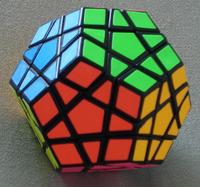
The Megaminx is a special puzzle to me because it is the first one that I learned how to solve by myself in its entirety. What I mean is that I worked out a method to solve the puzzle without any tutorial, which was a big deal for me.

The only thing I really knew about Megaminx was that it can be solved in a similar way to a 3x3 Rubik's cube. With that in mind, I started to solve it by making a 'star' on one side, and then inserting the corner pieces. Next, I moved onto the 'second' layer, and then I hit my first stump. What I managed was to solve the next section as one 'layer' by alternating edge and corner pieces; doing them one at a time, one after another, ending with a corner piece. Next is just the next layer of edges, and then the last layer. The last layer gave me some problems, but with a couple days of on and off work on it I figured out how to apply 3x3 algorithms to manage the last layer. While my method may not be terribly robust, I don't have any interest in speedsolving Megaminx, and so I will take my satisfaction in solving it and be done.


I haven't stopped there, however. I decided to move onto something bigger, and I purchased a Master Kilominx. An excellent puzzle after it was lubricated, I enjoyed the challenges it offered as an even layered minx puzzle. I was lucky with my first solve and did not end with parity, but the second time, there was parity, and i resorted to looking up an algorithm for the case. However, I did enjoy solving this puzzle as well, and it's one I do the odd time, so the parity is not a big deal.

I find minx puzzles to be an interesting challenge, and I plan to purchase a Gigaminx in the future. Although I do not want to speedsolve minx puzzles, I think they look awesome and are fun to play with, and of course are a great addition to a collection.

Until next time...

Wednesday, January 30, 2013

How I Learned to Solve the 3x3


As my first real topic, I want to talk about how I solve the 3x3. Like a lot of people I learned how to solve the Rubik's cube by watching pogobat 's (Dan Brown's) video on youtube, which has over 25 million views. I was off school with the chicken pox (an unusual age for them yes) and I got so bored that I decided I would learn how to solve the puzzle I got the year before. Learning the notation for the moves wasn't too difficult for me, but learning the few algorithms at first was intimidating. I told myself that it isn't much different than learning anything else, but I had difficulty. I managed to figure them out by just doing the algorithm over and over again until I could do it without reading it off the sheet of paper I had. Even now I still learn algorithms in a similar way, but it's a little easier now. After I learned how to solve the puzzle I practiced everyday at least a few solves, just to get better at it. After about a year I realized that there is so much more to solving the Rubik's cube than I had ever imagined. I discovered the world of speedcubing.

After I learned a little more about this 'speedsolving', I decided to look up what kind of things are done differently. I found the website cubefreak.net (link at the end) and it felt like I was hit with a shovel. And the very first thing I thought was 'I can never do this.' However, after reading some pages on the site, I figured I might as well try to ease into it. There is a page that discusses how to go from a beginner's method (such as Dan's) to speedcubing. I didn't exactly follow this, but I did go ahead and learn four-look last layer, which was probably the best decision I have made in my solving.

Basically, a beginners method solves the cube in layers, NOT sides as many think at first. The puzzle really has three layers, and you would first solve on layer, by putting the edges in place followed by the corners, and then complete the second layer, and finally the last layer. The most popular speed method these days solves the edges on the first layer (the cross) followed by the corners of the first layer and the edges of second layer simultaneously (F2L first two layers). To complete the cube there are two more steps, OLL (orientation) and PLL (permutation of last layer) OLL turns the pieces so the top side is done (all the same colours) and then moves them into the right place. When I solve the cube, I use a hybrid of these techniques, I solve the first layer by making the cross and placing the corners, then I solve the second layer as I would with just the beginners method. To finish I use four-look last layers, which is just OLL and PLL, each done in two steps. Full OLL has 57 cases in total, however doing it in two steps cuts down the number of algorithms to know. Same with PLL, it has 21 cases in total, but I use less than 10 algorithms.

So, that's a little story about how I learned to solve the Rubik's cube and how I solve it now.

Until next time...


Dan Brown's video on how to solve the cube:
http://www.youtube.com/watch?v=HsQIoPyfQzM

Cubefreak.net:
http://www.cubefreak.net/

Monday, January 28, 2013

My First Post!

Hey guys! This is my first blog post ever! My plan for this blog is to talk about my hobby, which involves twisty puzzles! I will be talking about solving different puzzles, including 3x3, about my collection and how it grows, and I will review some new puzzles as I receive them. I've only been at this for about 2 years but I feel that i have gained some knowledge over that time, and I want to share it with people. However, i have an exam tomorrow. So that's it for this!

Until next time..